
Learning to walk together and work together: providing a formative teaching experience for Indigenous and non-Indigenous heritage managers
Sullivan, Sharon, Hall, Nicholas, and Greer, Shelley (2008) Learning to walk together and work together: providing a formative teaching experience for Indigenous and non-Indigenous heritage managers. In: McManamon, Francis P., Stout, Andrew, and Barnes, Jodi A., (eds.) Managing Archaeological Resources:global context, national programs, local actions. One World Archaeology (58). Left Coast Press , Walnut Creek, CA, USA, pp. 35-54.
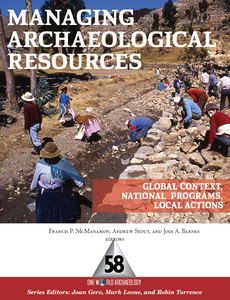
![[img]](https://researchonline.jcu.edu.au/7422/2/7422_Sullivan_et_al_2008_cover.jpg)
|
Image (JPEG) (Book Cover)
- Cover Image
Download (1MB) |
|
![[img]](https://researchonline.jcu.edu.au/style/images/fileicons/application_pdf.png)
|
PDF (Published Version)
- Published Version
Download (2MB) |

Abstract
[Extract] With the recognition of the diversity of rights- and stakeholders in the past, archaeologists and heritage managers are working increasingly to develop programmes that fit the needs of those stakeholders. In the 1970s in Australia, there was little recognition in law or policy of the connection between the academic study of Aboriginal archaeology and the contemporary Aboriginal community. This was particularly the case in southern Australia, where the Aboriginal community was considered, after 200 years of settlement, to have been severed from its traditional roots and indeed from any consciousness of or concern for the long and extraordinary history of Aboriginal occupation of Australia.
| Item ID: | 7422 |
|---|---|
| Item Type: | Book Chapter (Research - B1) |
| ISBN: | 978-1-59874-311-1 |
| Keywords: | cultural heritage; Uluru; Australian Aboriginal people; Anangu; heritage management training; community-based archaeology |
| Related URLs: | |
| Date Deposited: | 14 Jan 2010 23:26 |
| FoR Codes: | 21 HISTORY AND ARCHAEOLOGY > 2101 Archaeology > 210101 Aboriginal and Torres Strait Islander Archaeology @ 100% |
| SEO Codes: | 95 CULTURAL UNDERSTANDING > 9505 Understanding Past Societies > 950503 Understanding Australias Past @ 100% |
| Downloads: |
Total: 3797 Last 12 Months: 16 |
| More Statistics |
Actions (Repository Staff Only)
 |
Item Control Page |