
The role of behavioural variation in the invasion of new areas
Phillips, Ben L., and Suarez, Andrew V. (2012) The role of behavioural variation in the invasion of new areas. In: Candolin, Ulrika, and Wong, Bob B.M., (eds.) Behavioural Responses to a Changing World: Mechanisms and consequences. Oxford University Press, Oxford, UK, pp. 190-200.
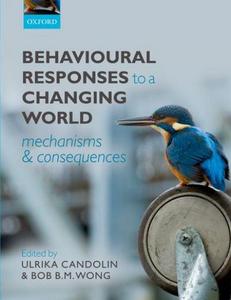
![[img]](https://researchonline.jcu.edu.au/23723/4/23723_Phillips%26Suarez_2012_Book_cover.jpg)
|
Image (JPEG) (Book Cover)
- Cover Image
Download (28kB) |
|
![[img]](https://researchonline.jcu.edu.au/style/images/fileicons/application_pdf.png) |
PDF (Published Version)
- Published Version
Restricted to Repository staff only |

Abstract
Behaviour determines the rate at which invasive species spread, as well as the impact they have on natives. When behaviour varies between individuals (as it almost always does), then the mean behaviour is often less important than the extremes of behaviour. The rate at which a species spreads, for example, is governed primarily by the most extreme dispersers. Similarly, individuals of native species that are extreme in their behaviour may be more, or less, likely to suffer impact from a given invasive species. Thus, we argue, an understanding of behavioural variation is critical if we are to understand the long-term impacts of invasive species in a changing world.
| Item ID: | 23723 |
|---|---|
| Item Type: | Book Chapter (Research - B1) |
| ISBN: | 978-0-19-960256-8 |
| Date Deposited: | 28 Nov 2012 23:22 |
| FoR Codes: | 05 ENVIRONMENTAL SCIENCES > 0501 Ecological Applications > 050103 Invasive Species Ecology @ 50% 06 BIOLOGICAL SCIENCES > 0603 Evolutionary Biology > 060308 Life Histories @ 50% |
| SEO Codes: | 96 ENVIRONMENT > 9604 Control of Pests, Diseases and Exotic Species > 960405 Control of Pests, Diseases and Exotic Species at Regional or Larger Scales @ 100% |
| Downloads: |
Total: 156 Last 12 Months: 3 |
| More Statistics |
Actions (Repository Staff Only)
 |
Item Control Page |