
Wildlife watching
Valentine, Peter, and Birtles, Alastair (2004) Wildlife watching. In: Higginbottom, Karen, (ed.) Wildlife Tourism: impacts, management and planning. Common Ground Publishing, Altona, VIC, Australia, pp. 15-34.
![[img]](https://researchonline.jcu.edu.au/style/images/fileicons/application_pdf.png) |
PDF (Published Version)
- Published Version
Download (117kB) |
|
![[img]](https://researchonline.jcu.edu.au/1639/2/1639_Valentine_%26_Birtles_2004.JPG)
|
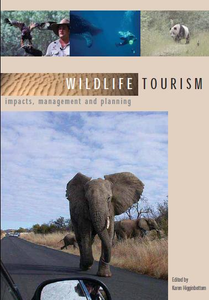
Image (JPEG) (Front Cover)
- Cover Image
Download (34kB) |

Abstract
[Extract] This chapter is concerned with wildlife tourism that is focused on watching free ranging animals in their natural habitats. It begins with a review of wildlife watching and classifications used to describe the activities and attractions involved. A central element is a global assessment of critical natural resources needed for wildlife watching including their geographical distribution. The chapter also provides a number of examples of different types of wildlife watching to assist the reader in appreciating some of the more experiential dimensions of this form of tourism. Several key aspects of sustainability are discussed using an example from marine wildlife watching.
Humans often have extremely intense and deeply personal experiences through wildlife watching and this may lead to outcomes that are extraordinary in their impacts on people's lives. At least some, if not most, forms of wildlife-watching tourism seek to provide just such an experience for their clients. There are many examples of intense encounters with wildlife in the literature, and the following account is from a famous scientist, co-author of the theory of evolution through natural selection. In this description one can sense the depth of emotion and excitement generated by his first encounter with a birdwing butterfly in the wild.
| Item ID: | 1639 |
|---|---|
| Item Type: | Book Chapter (Research - B1) |
| ISBN: | 978-1-86335-545-2 |
| Keywords: | ecotourism, wildlife tourism, free-ranging animals, natural habitat, sustainability, birds, mammals, butterflies, whales |
| Related URLs: | |
| Date Deposited: | 31 Aug 2007 |
| FoR Codes: | 15 COMMERCE, MANAGEMENT, TOURISM AND SERVICES > 1506 Tourism > 150605 Tourism Resource Appraisal @ 73% 05 ENVIRONMENTAL SCIENCES > 0502 Environmental Science and Management > 050211 Wildlife and Habitat Management @ 18% 06 BIOLOGICAL SCIENCES > 0603 Evolutionary Biology > 060302 Biogeography and Phylogeography @ 9% |
| SEO Codes: | 95 CULTURAL UNDERSTANDING > 9599 Other Cultural Understanding > 959999 Cultural Understanding not elsewhere classified @ 80% 96 ENVIRONMENT > 9608 Flora, Fauna and Biodiversity > 960808 Marine Flora, Fauna and Biodiversity @ 10% 96 ENVIRONMENT > 9608 Flora, Fauna and Biodiversity > 960806 Forest and Woodlands Flora, Fauna and Biodiversity @ 10% |
| Downloads: |
Total: 1550 Last 12 Months: 38 |
| More Statistics |
Actions (Repository Staff Only)
 |
Item Control Page |